
What Is Subtalar Arthritis? How to Treat It and Stay Active
Anyone who has felt a deep ache below the ankle after walking on uneven trails or standing for long shifts may be dealing with more than a simple sprain. What is subtalar arthritis? It is a degenerative or post-traumatic condition affecting the joint just beneath the true ankle joint, where the talus and calcaneus (heel bone) meet to allow the foot to tilt side to side. Because this joint governs how the foot adapts to uneven ground, damage here can quietly erode balance, walking tolerance, and overall activity levels long before pain becomes constant.
This guide covers why subtalar arthritis develops, the staged conventional treatment pathway from activity modification and bracing through injections and surgical fusion, and how regenerative approaches such as platelet-rich plasma (PRP) and mesenchymal stem cells are being explored as complementary options for joint pain and inflammation. The goal is realistic, evidence-based guidance for staying active while working with a qualified orthopedic provider.
What Is Subtalar Arthritis?
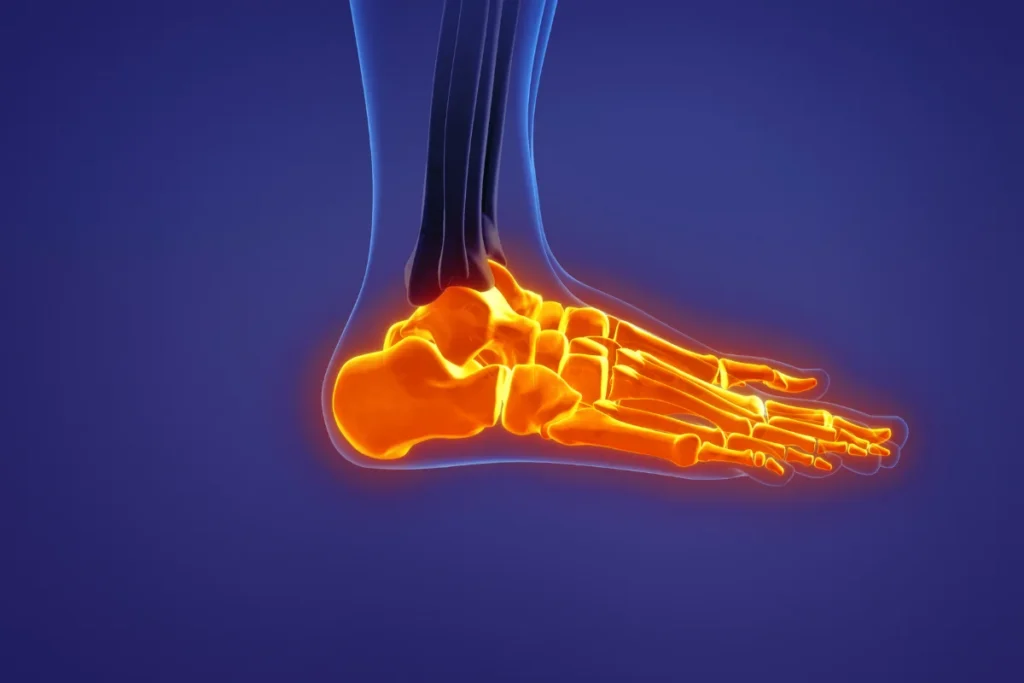
The subtalar joint sits directly below the ankle joint, formed by the underside of the talus and the top of the calcaneus. Unlike the ankle joint, which mostly allows up-and-down motion, the subtalar joint is responsible for inversion and eversion, the side-to-side tilting motions that let the foot adapt to slopes, curbs, and uneven terrain. When cartilage in this joint wears down or becomes inflamed, that adaptive motion becomes painful and restricted.
Subtalar arthritis has several common origins. Post-traumatic arthritis is the most frequently cited cause and often follows a calcaneal (heel bone) fracture, since fracture lines frequently extend into the joint surface and disrupt normal mechanics even after the bone heals. Research tracking patients after high-energy pilon fractures similarly found a meaningful proportion go on to develop subtalar joint arthritis (Joshi et al., J Bone Joint Surg Am, 2026). Degenerative wear-and-tear and inflammatory forms, such as rheumatoid arthritis, can also affect the joint, though post-traumatic causes dominate in clinical literature on this joint specifically (Stephens & Grujic, J Orthop Trauma, 2020).
Common symptoms include:
- Deep, aching pain below the ankle, often worse on uneven ground, gravel, or sloped surfaces
- Stiffness and a reduced ability to tilt the foot side to side (limited inversion and eversion)
- Swelling around the sinus tarsi, the small soft-tissue depression on the outer side of the hindfoot
- A sense of instability when walking on hills, stairs, or unpredictable terrain
- Pain that worsens with prolonged standing or activity and improves somewhat with rest
These symptoms can overlap with ankle arthritis, plantar fasciitis, or peroneal tendon problems, so an accurate diagnosis usually requires focused imaging rather than symptoms alone.
Conventional Treatment Options
Understanding how to treat subtalar arthritis starts with a staged approach that most orthopedic and podiatric providers follow, beginning conservatively and escalating only if symptoms persist or worsen.
Activity modification is often the first step. Reducing time spent on uneven or sloped terrain, adjusting footwear, and pacing high-impact activity can reduce mechanical stress on the joint without requiring any formal intervention.
Bracing and orthotics are commonly recommended next. A rigid or semi-rigid ankle-foot orthosis, or a custom orthotic that limits hindfoot motion, can reduce painful inversion and eversion while still allowing walking and daily function.
NSAIDs manage pain and inflammation flares, typically alongside, rather than instead of, mechanical support strategies.
Physical therapy maintains ankle and foot strength, improves gait mechanics, and reduces compensatory strain on nearby joints and tendons.
Corticosteroid injections into the subtalar joint may be used for more persistent pain, often guided by imaging given the joint’s small, complex anatomy.
Surgical fusion (arthrodesis) is generally reserved for advanced cases where conservative measures no longer provide adequate relief, aiming to eliminate painful motion while preserving surrounding foot and ankle function. Systematic reviews of subtalar distraction arthrodesis, often used when bone loss from a prior calcaneal fracture is present, report generally favorable pain relief and fusion rates, though outcomes vary with case complexity (Fletcher et al., Foot Ankle Int, 2020). Arthroscopic approaches have also been studied as a way to potentially reduce surgical morbidity while achieving comparable fusion outcomes in appropriately selected patients (Banerjee et al., J Foot Ankle Surg, 2021).
For readers exploring alternatives before considering fusion, our overview of ankle surgery alternatives to ankle fusion covers additional non-surgical and joint-preserving pathways relevant to hindfoot arthritis more broadly.
How Regenerative Medicine May Support Subtalar Joint Health
For patients weighing options between conservative care and surgical fusion, regenerative medicine is increasingly discussed as a complementary avenue for joint pain and inflammation, not a replacement for the staged approach above. PRP involves concentrating growth factors from a patient’s own blood and delivering them to the affected joint to support the local tissue environment. Mesenchymal stem cells (MSCs), sourced from bone marrow or adipose tissue, are of interest for their immunomodulatory and paracrine signaling properties, meaning they may help regulate inflammation rather than physically rebuild cartilage.
Evidence specific to the subtalar joint is still emerging. A preclinical study using an animal model of subtalar osteoarthritis found that a hydrogel delivering PRP-derived exosomes helped reduce chondrocyte (cartilage cell) apoptosis and supported chondrocyte proliferation compared to untreated joints, suggesting a possible mechanism by which PRP-based approaches could support cartilage health in this joint (Zhang et al., J Nanobiotechnology, 2022). Because this research was conducted in an animal model rather than human patients, it should be considered early-stage and mechanistic rather than clinical proof of benefit.
Bone marrow aspirate concentrate (BMAC), an orthobiologic containing a patient’s own MSCs, has been reviewed more broadly as a treatment being explored for ankle osteoarthritis, with authors noting encouraging early signals alongside gaps in standardized dosing and long-term outcome data (Hines et al., Cartilage, 2025). This same pattern, promising rationale paired with a still-developing clinical base, appears to apply to the subtalar joint specifically.
Regenerative approaches for subtalar arthritis are not first-line treatments and are not positioned to replace bracing, injections, physical therapy, or fusion surgery when those are clinically indicated. They are best understood as a complementary option some patients discuss with a regenerative medicine provider alongside their orthopedic care team. Readers curious how these cell-based approaches are used for foot pain more broadly may find our article on stem cell injections for foot pain helpful background.


The Evidence: What Research Shows
Taken together, the available research shows post-traumatic causes are well documented, surgical fusion has a substantial evidence base, and regenerative options remain an emerging area of study. Data following pilon fractures shows a notable share of patients develop subtalar arthritis over time, reinforcing the value of monitoring hindfoot joints after significant lower-leg trauma even when the primary fracture heals well (Joshi et al., J Bone Joint Surg Am, 2026). On the surgical side, systematic reviews of both distraction and arthroscopic arthrodesis techniques report generally favorable fusion rates and pain relief (Fletcher et al., Foot Ankle Int, 2020; Banerjee et al., J Foot Ankle Surg, 2021).
For regenerative options, the evidence base is considerably earlier-stage. Subtalar-specific exosome research is preclinical, conducted in an animal model rather than human patients, while broader ankle-focused BMAC research is described by its own authors as promising but still facing unresolved questions about protocols and long-term outcomes (Zhang et al., J Nanobiotechnology, 2022; Hines et al., Cartilage, 2025). This does not mean regenerative approaches lack promise, but expectations should be calibrated to where the science currently stands.
Staying Active: Safety Considerations and Realistic Expectations
An accurate diagnosis is the foundation for any subtalar arthritis treatment plan. Weight-bearing CT imaging and standard radiographs are commonly used to evaluate joint space narrowing, bone alignment, and any residual deformity from prior fractures, since plain X-rays alone can underrepresent the degree of subtalar joint involvement.
It is also important to understand the regulatory status of regenerative options. PRP and mesenchymal stem cell therapies for joint conditions, including subtalar arthritis, are not FDA-approved treatments for this indication and are considered investigational or complementary approaches. Anyone considering them should discuss realistic expectations, potential risks, and how these options fit alongside conventional care with a qualified orthopedic and regenerative medicine provider.
Staying active with subtalar arthritis is often possible with the right combination of mechanical support, appropriately timed conservative treatment, and, when needed, surgical intervention. Because every patient’s anatomy, injury history, and disease severity differ, personalized evaluation remains essential before starting any treatment path.
Frequently Asked Questions
What is subtalar arthritis?
Subtalar arthritis is inflammation and cartilage breakdown in the joint between the talus and calcaneus, located just below the true ankle joint. It commonly develops after calcaneal or pilon fractures, though degenerative and inflammatory causes also occur.
How do you treat subtalar arthritis?
Treatment typically starts with activity modification, bracing or custom orthotics, NSAIDs, and physical therapy. If symptoms persist, corticosteroid injections or surgical fusion may be considered, with regenerative options sometimes discussed as a complementary layer of care.
How is subtalar arthritis different from ankle arthritis?
The subtalar joint controls side-to-side foot tilting (inversion and eversion), while the true ankle joint above it primarily controls up-and-down motion. The two can be affected independently or together, which is why imaging is important for diagnosis.
What does subtalar arthritis pain feel like?
Most people describe a deep ache below the ankle, often worse when walking on uneven ground, slopes, or gravel. Stiffness, swelling near the sinus tarsi, and a sense of hindfoot instability are also common.
Is surgery always necessary for subtalar arthritis?
No. Many cases are managed successfully with bracing, orthotics, physical therapy, and injections. Surgical fusion is generally reserved for advanced or persistent cases that do not respond adequately to conservative care.
Can stem cell therapy treat subtalar arthritis?
Stem cell and PRP approaches are being explored as complementary options for joint pain and inflammation, but evidence specific to the subtalar joint remains early and largely preclinical. They are not FDA-approved for this use and are not considered first-line treatment.
Can subtalar arthritis get worse over time if untreated?
Cartilage damage in the subtalar joint is generally degenerative, meaning symptoms can progress without appropriate management. Early activity modification and mechanical support are often used to help slow progression and preserve function.
Key Takeaways
- What is subtalar arthritis: a degenerative or post-traumatic condition affecting the joint below the true ankle, most often following calcaneal or pilon fractures
- Key symptoms include deep hindfoot pain on uneven ground, stiffness, and limited inversion and eversion
- Conventional treatment is staged, starting with activity modification, bracing, orthotics, and NSAIDs before progressing to injections or surgery
- Surgical fusion, including distraction and arthroscopic techniques, has a reasonably strong evidence base for advanced disease
- Regenerative options such as PRP and mesenchymal stem cells are complementary, evidence for the subtalar joint specifically remains largely preclinical
- PRP and stem cell therapies for joint conditions are not FDA-approved and should not replace standard orthopedic care
- Weight-bearing CT imaging helps confirm diagnosis and guide treatment decisions
- Personalized evaluation by a qualified provider is essential before choosing any treatment path
Patients exploring options beyond conventional care may want to learn more about stem cell therapy as a complementary approach, or schedule a consultation to discuss whether it may fit alongside their existing treatment plan.
References
- Stephens AR, Grujic L. “Post-Traumatic Hindfoot Arthritis.” J Orthop Trauma. 2020;34(Suppl 1):S32-S37. DOI: https://doi.org/10.1097/BOT.0000000000001695
- Joshi R, Srinivas S, O’Neill C, Taseh A, Bhamidipati A, Acevedo D, Wang KY, Haleem AA, Ashkani-Esfahani S, Kwon JY. “The Prevalence of Subtalar Arthritis Following Pilon Fractures.” J Bone Joint Surg Am. 2026;108(2):114-119. DOI: https://doi.org/10.2106/JBJS.25.00233
- Fletcher AN, Liles JL, Steele JJ, Pereira GF, Adams SB. “Systematic Review of Subtalar Distraction Arthrodesis for the Treatment of Subtalar Arthritis.” Foot Ankle Int. 2020;41(4):437-448. DOI: https://doi.org/10.1177/1071100719899050
- Banerjee S, Gupta A, Elhence A, Choudhary R. “Arthroscopic Subtalar Arthrodesis as a Treatment Strategy for Subtalar Arthritis: A Systematic Review.” J Foot Ankle Surg. 2021;60(5):1023-1028. DOI: https://doi.org/10.1053/j.jfas.2021.04.006
- Zhang Y, Wang X, Chen J, Qian D, Gao P, Qin T, Jiang T, Yi J, Xu T, Huang Y, Wang Q, Zhou Z, Bao T, Zhao X, Liu H, Zheng Z, Fan J, Zhao S, Li Q, Yin G. “Exosomes Derived from Platelet-Rich Plasma Administration in Site Mediate Cartilage Protection in Subtalar Osteoarthritis.” J Nanobiotechnology. 2022;20(1):56. DOI: https://doi.org/10.1186/s12951-022-01245-8
- Hines SE, Makarczyk MJ, Heidinger E, Shang J, Lin H, Hogan MV. “Bone Marrow Aspirate Concentrate to Treat Ankle Osteoarthritis: A Narrative Review of Progress and Challenges.” Cartilage. 2025;19476035251389049. DOI: https://doi.org/10.1177/19476035251389049
Author: Ways2Well Editorial Team
Reviewed by: Scientific Advisory Board member