
Myasthenia gravis is an autoimmune condition that disrupts communication between nerve signals and muscles. For many patients, it causes fluctuating weakness that can be mildly limiting or, in some cases, profoundly debilitating. When symptoms escalate – or when a myasthenic crisis threatens breathing or swallowing – doctors often turn to plasmapheresis as one of the fastest ways to bring the immune attack under control.
Understanding how plasmapheresis for myasthenia gravis works, how quickly plasma exchange produces results, and what patients can realistically expect helps remove some of the uncertainty around this treatment.
What Is Myasthenia Gravis?
Myasthenia gravis (MG) is a chronic autoimmune neuromuscular disease. The immune system produces antibodies – most commonly against acetylcholine receptors (AChR) – at the neuromuscular junction, the site where nerves signal muscles to contract. When these antibodies block or destroy the receptors, the muscles do not respond normally to nerve signals.
The result is weakness that characteristically fluctuates and worsens with activity. Commonly affected muscles include those controlling eye movement and eyelid position (causing ptosis and double vision), swallowing, speaking, and breathing. Limb weakness is also present in many patients.
Symptoms tend to worsen with physical exertion and toward the end of the day, improving somewhat with rest. The severity ranges from mild ocular involvement to generalized weakness affecting daily function and, in serious cases, respiratory compromise.
MG is not curable, but it is treatable. Management ranges from acetylcholinesterase inhibitors (pyridostigmine) that improve neuromuscular transmission to immunosuppressive medications that reduce antibody production over time. For acute situations or when other treatments are insufficient, procedures like plasmapheresis come into play.
What Is Plasmapheresis and How Does It Work in Myasthenia Gravis?
Plasmapheresis – also called therapeutic plasma exchange (TPE) – is a blood purification procedure. Blood is drawn from the patient, the plasma (the liquid component that contains antibodies, inflammatory proteins, and other circulating factors) is separated from the blood cells, and the plasma is replaced with a substitute – typically albumin, fresh frozen plasma, or a combination. The cleaned blood is then returned to the patient.
In myasthenia gravis, the harmful AChR antibodies (and other MG-associated antibodies such as anti-MuSK) circulate in the plasma. Plasmapheresis removes these antibodies directly from circulation, reducing the immune attack on the neuromuscular junction.
This is why plasma exchange in myasthenia gravis produces relatively rapid effects compared to immunosuppressive medications, which take weeks to months to reduce antibody production.

How Quickly Does Plasma Exchange Work for Myasthenia Gravis?
One of the most common questions patients and families have is: how quickly does plasma exchange work?
Plasmapheresis generally begins producing noticeable clinical improvement within 2 to 5 days of starting a course of treatment. Meaningful improvement in muscle strength, swallowing, breathing, and ocular symptoms is typically observed by the end of a standard treatment course of 3 to 5 sessions.
The effects of plasma exchange in myasthenia gravis are relatively short-lived – lasting approximately 2 to 8 weeks in most patients. This is because the body continues to produce the harmful antibodies, and without ongoing immunosuppressive treatment, levels will gradually return.
For this reason, plasmapheresis is typically used:
- During acute exacerbations or myasthenic crisis – as a rapid rescue treatment to stabilize the patient
- Pre-operatively (before thymectomy or other surgery) – to reduce weakness and antibody levels before an operation
- As a bridge to longer-acting immunosuppressive therapies (azathioprine, mycophenolate, corticosteroids) while waiting for those treatments to take effect
Patients who respond well to plasmapheresis often require maintenance sessions – periodically repeating the procedure to keep antibody levels controlled when other therapies are insufficient.
What Does a Course of Plasma Exchange Involve?
A standard course of plasmapheresis for myasthenia gravis typically involves 5 treatments over 10 to 14 days (roughly every other day), though the exact number may vary based on clinical response and the patient’s overall condition.
Each session typically takes 2 to 4 hours. Vascular access – usually through a central venous catheter – is required for the procedure. Some patients receive a port or fistula if maintenance treatments are planned over the longer term.
Side effects are generally manageable:
- Fatigue during or after sessions
- Mild hypotension (low blood pressure) in some patients
- Tingling or cramping from changes in calcium levels (calcium supplementation is often given)
- Risk of infection at the catheter site with repeated access
The procedure itself is performed in a clinical setting with monitoring throughout. Most patients tolerate it well, though the time commitment and need for vascular access are practical considerations.
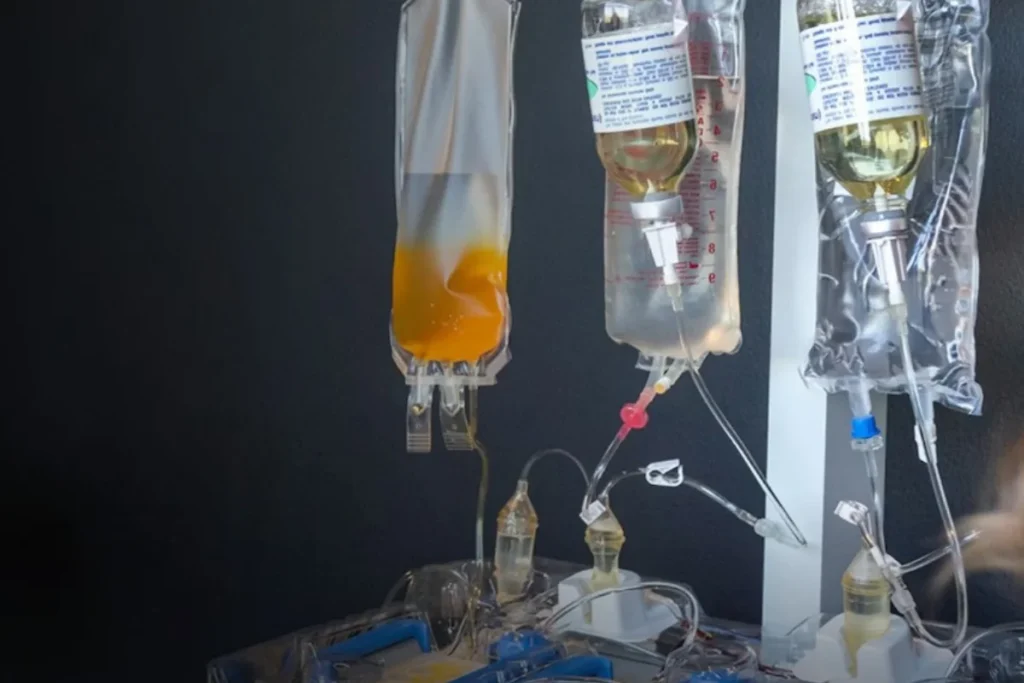
Plasma Exchange vs. IVIg in Myasthenia Gravis
Intravenous immunoglobulin (IVIg) is another treatment used in acute MG situations. The two approaches have similar effectiveness in clinical trials for acute myasthenic exacerbations, and the choice between them often depends on patient factors, access, and clinical context.
Plasma exchange works by physically removing antibodies. It tends to act slightly faster and is often preferred when rapid response is critical (such as in myasthenic crisis with respiratory compromise).
IVIg works through a different mechanism – infusing large amounts of normal immunoglobulin to modulate the immune system. It is easier to administer (no specialized equipment needed) and does not require central venous access, making it more practical in some settings.
Both are short-term interventions that should be part of a broader treatment plan addressing long-term disease management.
Plasmapheresis and Longer-Term Myasthenia Gravis Management
Ways2Well offers therapeutic plasma exchange and plasmapheresis services as part of a comprehensive approach to autoimmune and inflammatory conditions. For patients where myasthenia gravis plasmapheresis is needed on an ongoing basis for disease control, having access to a clinic that provides this treatment in a supported, personalized setting matters.
The goal of long-term MG management is to reduce dependence on acute interventions over time through:
- Appropriate immunosuppressive therapy
- Monitoring of antibody levels
- Thymectomy (removal of the thymus gland) in appropriate patients
- Lifestyle and wellness optimization that supports immune balance
Plasmapheresis is a powerful tool in the MG toolkit – but it works best as part of a coordinated care plan rather than a standalone repeated rescue.


FAQ
Plasmapheresis removes the harmful antibodies (typically anti-AChR antibodies) circulating in the blood that are attacking the neuromuscular junction. By reducing antibody levels, the immune attack is temporarily diminished, allowing neuromuscular transmission to partially recover.
A standard acute course involves approximately 5 sessions over 10 to 14 days. Some patients require maintenance plasmapheresis – ongoing periodic sessions – if their disease is not adequately controlled by immunosuppressive medications alone.
Clinical improvement typically begins within 2 to 5 days of starting treatment. By the end of a 5-session course, most patients show meaningful improvement in strength and function. The effects generally last 2 to 8 weeks.
Common side effects include fatigue, mild blood pressure changes, and tingling from electrolyte shifts. More serious risks – infection from catheter access, bleeding, or allergic reaction to replacement fluids – are less common but possible. The benefit-risk balance is generally favorable in patients with significant MG symptoms.
No. Plasmapheresis is a temporary treatment that reduces circulating antibody levels. It does not stop the immune system from producing new antibodies. Long-term disease management requires immunosuppressive medications, thymectomy in appropriate candidates, and ongoing monitoring.
Yes, in appropriate patients. Many plasmapheresis sessions are performed in outpatient settings, though patients with significant respiratory compromise or acute crisis typically require inpatient monitoring.
Key Takeaways
- Myasthenia gravis is an autoimmune condition in which antibodies block neuromuscular transmission, causing fluctuating muscle weakness
- Plasmapheresis for myasthenia gravis removes harmful antibodies from the blood through therapeutic plasma exchange
- How quickly plasma exchange works: typically within 2 to 5 days, with significant improvement after a full treatment course
- Effects last 2 to 8 weeks; plasmapheresis is typically used for acute exacerbations, pre-operative preparation, or as a bridge to longer-acting immunosuppression
- Plasma exchange and IVIg have similar efficacy in acute MG; choice depends on clinical factors and patient circumstances
- Long-term MG management goes beyond acute treatment to include immunosuppression, thymectomy where appropriate, and ongoing monitoring – myasthenia gravis plasmapheresis is one tool within a broader plan
Conclusion
Plasmapheresis is an important and often life-changing intervention for patients experiencing myasthenic crisis or significant MG exacerbations. Understanding how the procedure works, what to expect, and how it fits into the broader picture of disease management helps patients and families navigate a complex condition with more confidence. Ways2Well offers therapeutic plasma exchange and plasmapheresis services for patients with autoimmune and inflammatory conditions. Schedule a consultation to discuss whether plasma exchange may be appropriate as part of your treatment plan.
Sources
- Myasthenia Gravis Fact Sheet – NINDS/NIH
- Myasthenia Gravis: Symptoms & Treatment – Cleveland Clinic
- Plasmapheresis (Plasma Exchange): Procedure & What It Is – Cleveland Clinic
- Lymphoplasmapheresis versus Plasma Exchange in Severe Myasthenia Gravis – PMC/NIH
Author: Ways2Well Editorial Team
Reviewed by: Scientific Advisory Board member