
Patellofemoral pain syndrome is one of the most common causes of knee pain in active adults and adolescents. Often called “runner’s knee,” it is not limited to runners – it affects hikers, cyclists, desk workers, and anyone who places repetitive load on the knee without adequate preparation or recovery. The hallmark is aching pain around or behind the kneecap that tends to worsen with activities like climbing stairs, squatting, running, or sitting for extended periods.
Understanding what causes this condition, what symptoms to watch for, and what effective treatment actually involves can make a significant difference in recovery.
What Is Patellofemoral Pain Syndrome?
The patellofemoral joint is the interface between the patella (kneecap) and the femur (thigh bone). Normally, the patella glides smoothly within a groove on the femur as the knee bends and straightens. When the tracking of the patella is disrupted – due to muscle imbalances, overuse, alignment issues, or other factors – abnormal stress is distributed across the cartilage and soft tissue of the joint. Over time, this produces pain and inflammation.
Patellofemoral pain syndrome (PFPS) is diagnosed based on symptoms and examination findings, as imaging often does not reveal obvious structural damage in early cases. The condition exists on a spectrum – from mild discomfort that resolves with activity modification to chronic, persistent pain that significantly limits activity.
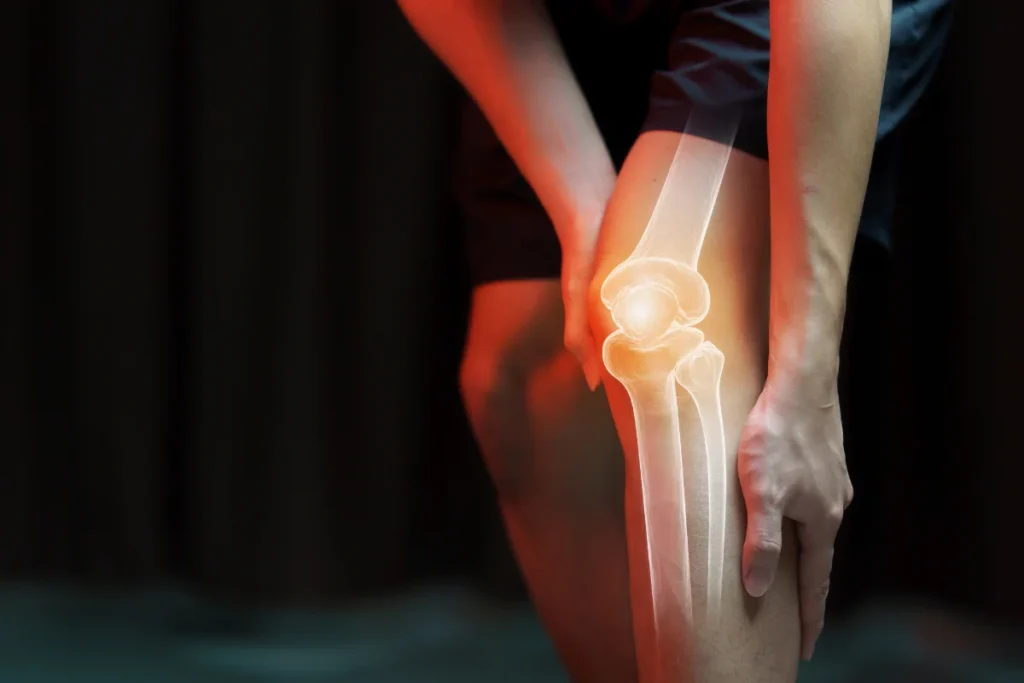
Causes of PFPS
PFPS rarely has a single cause. It is typically the result of multiple contributing factors that together overload the patellofemoral joint.
Overuse and training load errors are among the most common triggers. Rapidly increasing running mileage, adding new lower-body exercises, or returning to activity after a period of inactivity can all overwhelm the joint’s capacity.
Muscle weakness and imbalances play a central role. Weakness in the hip abductors and external rotators allows the thigh to turn inward during activity, which shifts the load on the patellofemoral joint. Weak quadriceps – particularly the VMO (vastus medialis oblique, the teardrop-shaped muscle at the inner knee) – reduce the kneecap’s ability to track centrally.
Tight muscles also contribute. Tight hip flexors, hamstrings, and iliotibial bands alter knee mechanics and increase patellofemoral stress during movement.
Biomechanical factors such as flat feet (overpronation), high arches, or patellar tilt can change how forces travel through the knee.
Cartilage changes may develop over time. While PFPS is not purely a cartilage condition, chronic abnormal loading can contribute to early softening or irritation of the cartilage surfaces within the patellofemoral joint.
Symptoms of Patellofemoral Syndrome
The symptoms are fairly recognizable:
- Anterior knee pain – aching discomfort at the front of the knee, behind or around the kneecap
- Pain with loaded knee flexion – worsens when squatting, kneeling, walking downstairs, or standing up from a chair
- Pain after prolonged sitting – the “movie sign,” where the knee stiffens and aches after extended sitting with the knee bent
- Activity-related pain – discomfort during running, cycling, or jumping that may ease briefly and then worsen
- Occasional grinding or crepitus – a crackling or grating sensation with movement
- Swelling – mild, diffuse swelling around the kneecap in more irritated cases
Pain that is sharp, associated with locking, or accompanied by significant swelling warrants more thorough evaluation to rule out other knee pathology.
Treating Patellofemoral Syndrome: Conventional Approaches
Treating patellofemoral syndrome is primarily rehabilitation-based, and research consistently shows that targeted exercise therapy is the most effective long-term approach.
Physical therapy and progressive exercise are the cornerstone of management. A structured program that addresses hip and quadriceps strength, movement quality, and flexibility consistently produces meaningful improvement. Hip strengthening in particular – targeting the glutes and hip abductors – has strong evidence for reducing patellofemoral pain by improving lower limb alignment.
Load management involves temporarily reducing activities that provoke symptoms while maintaining overall fitness. This is not the same as complete rest – continuing appropriate activity while reducing irritating forces is typically more effective than stopping exercise entirely.
Orthotics and footwear can help in patients where foot pronation or alignment issues are contributing to knee mechanics. Soft arch supports or motion-control footwear may offload the patellofemoral joint.
Patellar taping (McConnell taping) is sometimes used short-term to provide pain relief during rehabilitation by adjusting how the kneecap tracks.
Anti-inflammatory medications and ice can reduce acute pain and swelling but do not address the underlying causes.
Regenerative Options for Patellofemoral Syndrome
For patients with persistent symptoms – particularly where imaging reveals cartilage changes or where conventional rehabilitation has not produced adequate improvement – regenerative medicine approaches may be appropriate to consider alongside continued rehabilitation.
Stem cell therapy using mesenchymal stem cells (MSCs) has been studied for cartilage pathology and joint inflammation. In cases with underlying cartilage involvement, stem cell therapy may help reduce inflammation within the joint and potentially support tissue regeneration. MSCs are thought to secrete signaling molecules that promote healing and modulate the inflammatory environment – processes relevant to patellofemoral joint health.
PRP (platelet-rich plasma) injections concentrate growth factors from the patient’s own blood and may support tissue healing and pain reduction in the joint. It is often used in conjunction with physical therapy rather than as a replacement for it.
These regenerative options are generally considered for patients who have not achieved adequate improvement through comprehensive conservative care, and their use should be guided by a thorough clinical evaluation.
FAQ
There is no shortcut – the most reliably effective approach is progressive strengthening, particularly of the hip muscles and quadriceps, combined with load management. Starting with a well-designed physical therapy program early, before the condition becomes chronic, typically leads to the fastest and most durable recovery.
PFPS is not life-threatening and does not always indicate severe structural damage. However, left unaddressed, it can become chronic and significantly limit activity. Cartilage changes may develop over time with persistent abnormal loading. Taking it seriously and addressing contributing factors early leads to better outcomes.
Generally, yes – with appropriate modifications. Activities that load the knee heavily in a bent position (deep squats, running, climbing stairs) often need to be temporarily reduced. Low-impact activities that maintain fitness without aggravating the knee (swimming, cycling with seat adjustment, upper body training) are typically appropriate during rehabilitation.
Recovery is individual. With consistent physical therapy and load management, many patients see meaningful improvement within 6 to 12 weeks. Chronic cases or those with underlying cartilage changes may take several months. Maintaining the strength gains from rehabilitation is essential for preventing recurrence.
For some patients, reducing activity and waiting allows symptoms to settle. However, without addressing the underlying muscle weaknesses and biomechanical factors, the problem typically returns when activity resumes. Structured rehabilitation is more reliable for durable resolution.
For cases involving cartilage changes or persistent joint inflammation, stem cell therapy may support tissue health and reduce inflammation within the patellofemoral joint. It is typically considered as part of a comprehensive plan when conservative treatment has been insufficient, not as a first-line standalone option.
Key Takeaways
- Patellofemoral pain syndrome is a common knee condition caused by abnormal patellar loading, usually from muscle weakness, overuse, or biomechanical factors
- Symptoms include anterior knee pain that worsens with squatting, stairs, running, and prolonged sitting
- Effective treatment centers on progressive hip and quadriceps strengthening, load management, and addressing contributing factors
- Regenerative approaches including stem cell therapy may support healing in cases with underlying cartilage involvement or persistent inflammation
- Recovery with consistent rehabilitation typically takes weeks to months, depending on severity and chronicity
- Addressing the root causes through exercise therapy leads to more durable outcomes than passive treatments alone
Conclusion
This knee condition is manageable, and most people can achieve meaningful recovery with the right approach. The key is addressing not just the pain but the underlying factors driving the problem. Ways2Well offers a proactive, personalized approach to musculoskeletal health – including stem cell therapy for patients dealing with joint and cartilage issues. If your knee pain has not responded to conventional care, schedule a consultation to explore what options may be right for you.
Sources
- Patellofemoral Pain Syndrome: Symptoms and Causes – Mayo Clinic
- Patellofemoral Pain Syndrome: Diagnosis and Treatment – Mayo Clinic
- Patellofemoral Pain Syndrome – OrthoInfo AAOS
- Patellofemoral Pain Syndrome (PFPS): Symptoms & Treatment – Cleveland Clinic
Author: Ways2Well Editorial Team
Reviewed by: Scientific Advisory Board member