
Achilles tendinopathy is one of the most frustrating overuse injuries in sports and active adults. The Achilles tendon – the large cord connecting the calf muscles to the heel bone – is under enormous load during walking, running, and jumping. When that load consistently exceeds what the tendon can handle, the tissue begins to degenerate rather than repair itself normally. The result is pain, stiffness, and sometimes swelling that can persist for months if not properly addressed.
Understanding the available treatment options and what realistic recovery looks like is essential for anyone dealing with this condition.
What Is Achilles Tendinopathy?
Achilles tendinopathy is not a single injury – it is a spectrum of tendon pathology ranging from mild reactive tendinopathy (early-stage, reversible cellular changes) to degenerative tendinopathy (chronic structural disorganization of the tendon tissue).
There are two main anatomical subtypes:
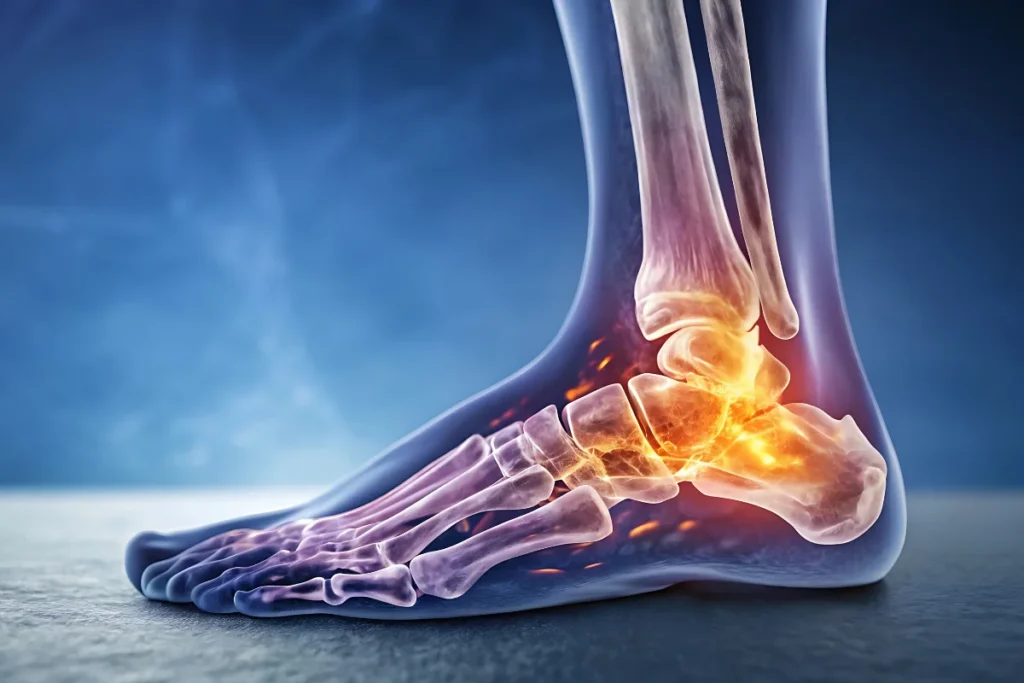
Mid-portion Achilles tendinopathy occurs 2 to 6 centimeters above the heel bone. This is the more common form, typically seen in runners and active adults. The tendon in this zone is relatively avascular, meaning blood supply is limited, which contributes to slow healing.
Insertional Achilles tendinopathy occurs at the point where the tendon attaches to the heel bone (calcaneus). This form is often associated with calcium deposits, heel bone spurs, and Haglund’s deformity (a bony prominence). The insertional form requires a slightly different approach than the mid-portion variety.
Both types share the core features: pain with loading activity, morning stiffness, and a tendon that feels thick or nodular on palpation.
What Causes Achilles Tendinopathy?
The underlying driver is a mismatch between load applied to the tendon and the tendon’s capacity to absorb and recover from that load. This mismatch can develop from:
- A rapid increase in training volume or intensity (the “too much, too soon” pattern)
- Insufficient recovery time between training sessions
- Calf muscle weakness or tightness placing greater strain on the tendon
- Hard or unsupportive footwear
- Running surface changes (switching to harder surfaces)
- Biomechanical factors such as overpronation or altered gait mechanics
- Age-related changes in tendon structure and elasticity
Older adults, post-menopausal women, and individuals with metabolic conditions (including elevated cholesterol or obesity) are also at increased risk.
Achilles Tendinopathy Treatment: The Evidence-Based Approach
Tendinopathy responds best to a structured, progressive loading program – not rest alone. Research consistently shows that tendons require controlled mechanical stimulus to adapt and strengthen.
Eccentric and Heavy Slow Resistance Loading
The most evidence-supported treatment for mid-portion Achilles tendinopathy is eccentric heel drop exercise – a specific protocol involving the slow lowering of the heel below the edge of a step. Research indicates that this kind of loading helps reorganize and strengthen degenerative tendon tissue over time.
Heavy slow resistance (HSR) training – using slow, controlled movements with significant load – has also shown strong results in clinical studies and is particularly well-tolerated in patients who cannot perform eccentric exercises without pain.
For insertional presentations, standard eccentric heel drops are often modified because loading the tendon in a fully stretched position can compress the insertion zone and worsen symptoms.
Physical Therapy and Load Management
A progressive return-to-activity program guided by a physiotherapist typically forms the backbone of treatment. This involves carefully managing load, modifying activities to allow the tendon to adapt, and gradually rebuilding capacity.
Shockwave therapy – applying acoustic energy pulses to the tendon – is another option with emerging evidence, particularly for chronic cases that have not responded to exercise alone.
Anti-Inflammatories and Injections
NSAIDs may provide short-term pain relief but have limited effect on tendon healing. Corticosteroid injections, while providing temporary relief, are generally avoided in tendinopathy because research suggests they may accelerate tendon degeneration with repeated use.
Regenerative Achilles Tendinopathy Treatment Options
For patients whose tendinopathy has not responded adequately to conservative measures, regenerative medicine approaches offer an additional avenue.
PRP (platelet-rich plasma) injections use concentrated growth factors from the patient’s own blood to create a healing stimulus in the tendon. Clinical research on PRP for Achilles tendinopathy is mixed but generally shows promise in carefully selected patients – particularly for mid-portion tendinopathy.
Stem cell therapy represents an evolving frontier in tendon care. Mesenchymal stem cells (MSCs) are thought to support healing through several mechanisms: reducing chronic inflammation, secreting growth factors that stimulate tendon cell activity, and potentially contributing to tissue regeneration. Stem cell therapy may be particularly relevant for chronic degenerative tendinopathy where the tissue has lost its capacity for self-repair under loading alone.
These approaches are typically used as part of a broader rehabilitation plan rather than standalone treatments, and not every patient is an appropriate candidate.
What to Expect During Recovery
Recovery from Achilles tendinopathy is rarely quick, but it is achievable with the right approach.
For early-stage or reactive tendinopathy, a well-managed loading program may produce significant improvement within 6 to 12 weeks. For chronic degenerative tendinopathy – particularly cases lasting more than 3 months – realistic timelines are typically 3 to 6 months of structured rehabilitation before full return to sport or demanding activity.
Treatment options work best when:
- Load is managed intelligently – not too much, not complete rest
- The program is consistent over time (tendons adapt slowly)
- Contributing factors (calf weakness, footwear, biomechanics) are addressed
- Progress is tracked and treatment is adjusted based on response
Setbacks are common in tendinopathy recovery, but they do not mean the tendon cannot heal. Adjusting load and maintaining consistency typically leads to meaningful improvement over time.
FAQ
Progressive loading exercise – particularly eccentric heel drops and heavy slow resistance training – is the most evidence-supported approach for mid-portion Achilles tendinopathy. The specific protocol should be tailored to the individual’s pain level and stage of tendinopathy, ideally under the guidance of a physiotherapist.
Yes. Insertional tendinopathy often requires modified exercise protocols because standard eccentric movements that load the tendon at full stretch can compress the insertion zone. Shockwave therapy and corticosteroid injections are also used differently, and surgical considerations differ between the two locations.
Early-stage tendinopathy may improve significantly within weeks to a few months with appropriate treatment. Chronic or degenerative cases typically require 3 to 6 months of consistent rehabilitation. Some patients benefit from longer programs, particularly when regenerative treatments are incorporated.
Stem cell therapy is being studied for tendinopathy and may support healing by reducing inflammation and stimulating tendon cell activity. It is generally considered when conservative treatment has not produced sufficient improvement. Individual response varies, and a full clinical evaluation helps determine whether it may be appropriate.
Untreated tendinopathy can progress from reversible tissue changes to irreversible degeneration. In some cases, it can predispose the tendon to partial or complete rupture. Pain that interferes with daily function or sport warrants evaluation rather than simply hoping it resolves on its own.
Complete rest is rarely recommended. Tendons need loading to adapt and heal. The goal is to find the appropriate level of load – enough to stimulate adaptation without causing harm. Activity modification is generally preferred over complete immobilization.
Key Takeaways
- Achilles tendinopathy is a degenerative tendon condition, not simply inflammation, and responds best to progressive loading rather than rest alone
- Mid-portion and insertional presentations differ in exercise approach and management strategy
- Eccentric and heavy slow resistance exercise programs are the most evidence-supported first-line options for this condition
- PRP and stem cell therapy represent regenerative alternatives for chronic cases that haven’t responded to conservative care
- Recovery timelines range from weeks to several months depending on severity and chronicity
- Addressing contributing factors (calf strength, biomechanics, footwear) is essential for lasting resolution
Conclusion
Achilles tendinopathy responds well to the right approach, but it requires patience and consistency. Whether you are in the early stages or dealing with a chronic case that has not resolved with conventional treatment, there are options worth exploring. Ways2Well offers regenerative medicine services including stem cell therapy and a proactive, comprehensive approach to tendon and musculoskeletal health. Schedule a consultation to discuss what achilles tendinopathy treatment approach may be most appropriate for your situation.
Sources
- Achilles Tendinitis: Symptoms and Causes – Mayo Clinic
- Achilles Tendinitis: Symptoms & Treatment – Cleveland Clinic
- Achilles Tendinitis – OrthoInfo AAOS
- Efficacy of PRP in Treatment of Achilles Tendinopathy: Meta-Analysis – PMC/NIH
Author: Ways2Well Editorial Team
Reviewed by: Scientific Advisory Board member