
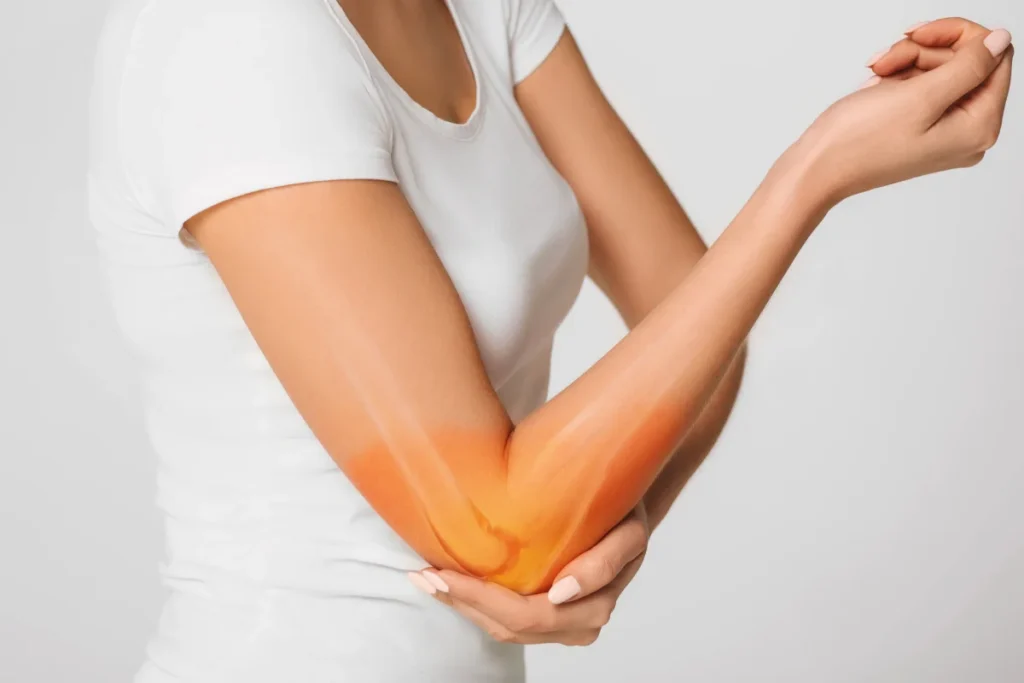
Throbbing pain in left arm woman symptoms are searched often, and for good reason – arm pain can come from something as ordinary as sleeping in an awkward position or as serious as a heart attack. Because women are more likely than men to experience atypical cardiac symptoms, a throbbing ache in the left arm deserves a closer look rather than a quick dismissal.
The good news: most of the time, throbbing arm pain has nothing to do with the heart at all. It usually traces back to a strained muscle, an irritated tendon, or – more often than people expect – a compressed nerve starting in the neck or shoulder rather than an injury in the arm itself. This guide walks through the full range of possibilities, starting with the warning signs that should never be ignored.
When to Seek Emergency Care
Call 911 or emergency services immediately if throbbing arm pain occurs together with any of the following:
- Chest pain, pressure, tightness, or a squeezing sensation
- Pain that spreads to the jaw, neck, back, or shoulder
- Shortness of breath, even without chest discomfort
- Sudden, severe, or unexplained onset of arm pain
- Nausea, cold sweat, lightheadedness, or fainting
- Unusual fatigue or a sense that “something is wrong,” particularly in women
Women having a heart attack often do not experience classic crushing chest pain. Research shows women are more likely than men to report pain in the arm, jaw, neck, or upper back, sometimes with little or no chest discomfort at all (Ferry et al., Journal of the American Heart Association, 2019). If there is any doubt, err on the side of calling emergency services – do not drive yourself to the hospital.
Musculoskeletal Causes of Throbbing Arm Pain
Once emergencies are ruled out, the most common causes of throbbing arm pain are musculoskeletal. A pulled or overworked muscle, tendinopathy, or bursitis can all produce a deep, throbbing ache that worsens with movement or pressure.
Rotator cuff tendinopathy is a frequent culprit behind throbbing upper arm pain at night – degenerative changes or overuse in the tendons can cause pain that radiates down the outer arm and intensifies when lying on the affected side (Factor & Dale, International Journal of Sports Physical Therapy, 2014). Other contributors include muscle strain from exercise or repetitive lifting, tennis or golfer’s elbow, and bursitis of the shoulder or elbow. These causes typically correlate with a specific activity, feel worse with movement, and improve somewhat with rest, ice, or over-the-counter anti-inflammatory measures.
Nerve-Related Causes: Often the Real Source of the Pain
Here’s what surprises many people: throbbing arm pain is often a symptom of nerve compression – such as a pinched nerve in the neck or shoulder – rather than a true arm injury. The arm itself can be structurally fine while the actual problem sits upstream, at the point where a nerve root exits the spine or passes through a tight space near the shoulder.
Cervical radiculopathy occurs when a nerve root in the neck is compressed, often by a herniated or degenerated disc. It typically produces sharp, electric, or throbbing pain that radiates from the neck down the arm along a specific pathway, frequently with numbness, tingling, or weakness (Caridi et al., HSS Journal, 2011).
Thoracic outlet syndrome is another nerve-related (and sometimes vascular) cause, occurring when nerves or blood vessels are compressed between the collarbone and first rib. Symptoms may include throbbing pain, tingling, or weakness radiating down the arm toward the ring and little fingers, often worsened by overhead activity (Li et al., Journal of Clinical Medicine, 2021).
Because these two conditions look and feel like an arm problem while actually originating in the neck or shoulder, they’re commonly missed on a first look at the arm alone.
Vascular and Cardiac Causes of Throbbing Arm Pain
Vascular and cardiac causes are less common but carry the highest stakes.
Poor circulation and vascular compression. Reduced blood flow to the arm – from vascular compression, peripheral artery disease, or other circulatory issues – can cause throbbing pain along with coldness, paleness, or bluish discoloration in the hand or fingers.
Upper extremity deep vein thrombosis (DVT). A blood clot in the deep veins of the arm may cause sudden, throbbing pain along with swelling, warmth, or redness. It’s less common than DVT in the legs but is a genuine medical emergency, since the clot can travel to the lungs (Mustafa et al., Israel Medical Association Journal, 2018).
Cardiac causes (angina and heart attack). Reduced blood flow to the heart can refer pain into the left arm – and less commonly the right – because the heart and arm share overlapping nerve pathways. This is the reason “throbbing pain in left arm woman” is such a common search: cardiac-related arm pain is often a dull ache or heaviness rather than sharp pain, and may appear with minimal or no chest discomfort, particularly in women (Gulati et al., Circulation, 2021).
How Regenerative Medicine May Help Address the Underlying Cause
For the nerve-related causes above, treating the arm alone often misses the point – the pain resolves only once the compression at its source is addressed. This is where regenerative options like stem cell therapy are being explored as a complementary approach.
Rather than just managing the ache, stem cell therapy is being studied for its potential to support healing in the tissue actually causing the nerve compression – for example, a degenerating cervical disc pressing on a nerve root, or a torn rotator cuff altering shoulder mechanics enough to irritate nearby nerves. The idea is that by supporting repair in the underlying disc or tendon, the compression driving the nerve pain may ease as well, rather than only masking the discomfort with rest or medication. Our articles on stem cell therapy for degenerative disc disease and relieving pain after rotator cuff injury with stem cells go into more depth on each of these pathways.
It’s important to set realistic expectations: this is a complementary, evolving area of care, not a replacement for emergency evaluation, physical therapy, or surgical treatment when those are indicated. Anyone considering a regenerative approach for arm or nerve-related pain should first have the underlying cause properly diagnosed by a healthcare provider.
Frequently Asked Questions
Is throbbing pain in the left arm always a sign of a heart attack?
No. Most throbbing left arm pain is caused by muscle strain, tendinopathy, or nerve compression rather than the heart. However, because cardiac-related arm pain can mimic these benign causes – especially in women – any sudden or unexplained throbbing pain, particularly with chest pressure, shortness of breath, or nausea, should be evaluated urgently.
Does throbbing pain in right arm matter as much as left arm pain?
Yes. While left arm pain is more classically associated with cardiac events, throbbing pain in right arm can also be cardiac in origin and should not be assumed benign just because it is on the “wrong” side. Any arm pain accompanied by chest pressure, jaw pain, or shortness of breath warrants emergency evaluation regardless of which arm is affected.
Why is my upper arm throbbing at night specifically?
Throbbing upper arm pain at night is frequently linked to rotator cuff tendinopathy or bursitis, since lying down compresses the shoulder and removes the daytime distraction that masks discomfort. Nighttime pain that recurs regularly or comes with weakness should be evaluated by a healthcare professional.
How can I tell if arm pain is muscular versus nerve-related?
Muscular pain usually correlates with a specific movement or activity and stays localized to the arm or shoulder. Nerve-related pain, such as from cervical radiculopathy, often radiates from the neck down the arm in a specific pattern and may include numbness, tingling, or weakness.
Can stem cell therapy help arm pain caused by a pinched nerve?
It may help in select cases. When nerve compression traces back to a degenerating disc or a rotator cuff injury, stem cell therapy is being explored as a way to support healing in that underlying tissue, which may in turn ease the nerve impingement responsible for the pain. It’s considered a complementary, still-developing option rather than a first-line or guaranteed treatment.
Should I go to urgent care or the emergency room for arm pain?
If there is any chest pain, pressure, shortness of breath, jaw or back pain, sudden severe onset, or other red-flag symptoms, call emergency services rather than going to urgent care. For arm pain without these features that has persisted for days or weeks, a primary care or specialist evaluation is appropriate.
Key Takeaways
- Throbbing pain in left arm woman symptoms can range from a harmless muscle strain to a sign of cardiac trouble, and the two can look surprisingly similar.
- Women often experience atypical heart attack symptoms, including arm, jaw, or back pain with little or no chest discomfort – never dismiss these signs.
- Musculoskeletal causes like rotator cuff tendinopathy are the most common source of nighttime throbbing in the upper arm.
- Throbbing arm pain is often a symptom of nerve compression – a pinched nerve in the neck or shoulder – rather than a true arm injury.
- Cervical disc issues and rotator cuff tears are two underlying causes of that nerve compression, and regenerative options like stem cell therapy are being explored to support healing at the source.
- Vascular causes, including upper extremity DVT, can cause sudden swelling and throbbing pain and require prompt evaluation.
Once emergencies are ruled out and the underlying cause is identified, addressing the source – not just the ache – is often the more lasting path forward. Learn more about how stem cell therapy may support recovery from nerve-compressing conditions like disc degeneration or rotator cuff injury, or schedule a consultation to discuss your symptoms with our team.
References
- Ferry AV, Anand A, Strachan FE, et al. “Presenting Symptoms in Men and Women Diagnosed With Myocardial Infarction Using Sex-Specific Criteria.” Journal of the American Heart Association, 2019;8(17):e012307. DOI: https://doi.org/10.1161/JAHA.119.012307
- Gulati M, Levy PD, Mukherjee D, et al. “2021 AHA/ACC/ASE/CHEST/SAEM/SCCT/SCMR Guideline for the Evaluation and Diagnosis of Chest Pain.” Circulation, 2021;144(22):e368-e454. DOI: https://doi.org/10.1161/CIR.0000000000001029
- Caridi JM, Pumberger M, Hughes AP. “Cervical Radiculopathy: A Review.” HSS Journal, 2011;7(3):265-272. DOI: https://doi.org/10.1007/s11420-011-9218-z
- Li N, Dierks G, Vervaeke HE, et al. “Thoracic Outlet Syndrome: A Narrative Review.” Journal of Clinical Medicine, 2021;10(5):962. DOI: https://doi.org/10.3390/jcm10050962
- Mustafa J, Asher I, Sthoeger Z. “Upper Extremity Deep Vein Thrombosis: Symptoms, Diagnosis, and Treatment.” Israel Medical Association Journal, 2018;20(1):53-57. URL: https://pubmed.ncbi.nlm.nih.gov/29658209/
- Factor D, Dale B. “Current Concepts of Rotator Cuff Tendinopathy.” International Journal of Sports Physical Therapy, 2014;9(2):274-288. URL: https://pmc.ncbi.nlm.nih.gov/articles/PMC4004132/
Author: Ways2Well Editorial Team
Reviewed by: Scientific Advisory Board member